
Mothra. A new Kaiju star in the sky and dark matter

Mothra is believed to be a binary system, with a cold (red) star and a hot (blue) star orbiting around the common center of mass. The red companion is observed to be varying with time, a common situation in this type of systems.

Monster stars are giant superluminous stars, tens of thousands or hundreds of thousands brighter than the Sun. Despite their superb luminosity, with the most powerfull telescopes they can only be seen in our Galaxy or in galaxies nearby. However, astronomers can rely on a trick offered by nature to see these stars much, much farther away. As predicted by general relativity, space can bend in the presence of very massive objects. Light traveling through that warped space bends as well, and can be focused into our telescopes in the same way a piece glass that is shaped into a lens can focus light into a focal point.

The most massive objects known capable of bending space are galaxy clusters, with masses up to thousands of times the mass of our own Galaxy. If a telescope points towards one of these massive galaxy clusters, objects that are very far away and right behind the cluster can be magnified, the same way a lens at the end of a telescope would magnify distant objects. The combined effect of a human made telescope looking through the natural telescope that is a galaxy cluster is similar to a larger telescope, hence allowing to see objects that are too faint to be observed directly without the aid of these natural telescopes. The magnification provided by these natural telescopes (galaxy clusters) is not uniform, and there is a very narrow region around the center of the galaxy cluster where the magnification factor can reach several thousands. These narrow regions are known as critical curves and objects that are observed near these curves are magnified by very large factors. With magnification factors ~1000 provided by these natural lenses, a telescope such as the JWST (with a mirror size of ~6 m) observing a star near a critical curve becomes the equivalent of a giant telescope with a mirror size of ~200 meters in diameter. That is, 20 times larger than the largest telescope on Earth (The Spanish GTC in the Canary Islands). With such giant telescopes, astronomers can see very luminous individual stars at very large distances, provided these stars happen to be observed close enough to a critical curve.

Several stars have been observed this way, and in previous posts we have discussed a few of them (Earendel, Godzilla). In a recent work, we present a new Kaiju star named Mothra, which is specially interesting because it can be used to study models of dark matter (DM), arguably, the most mysterious substance in the universe (with the permission of space itself). When observing lensed stars with very large magnification factors, we often see a double image of the star twice, one on each side of the critical curve but very close to it. One of the star has positive parity (that is, it represents a direct image of the true image), and the other has a negative parity (that is, it appears as a reflection of the true image). For stars, we can not directly observe the parity since we only measure their fluxes, and we can not resolve the star even with magnification factors of several thousands. However, the parity of the image can be easily established from a model of the galaxy cluster. In the case of Mothra, we only see one of the two expected images. This is not unusual for images that have positive parity, since images of stars with negative parity are often demagnifed by tiny lenses in the galaxy cluster. This tiny lenses are stars in the galaxy cluster that introduce small imprefections on the otherwise nearly perfectly smooth gravitational lens.

One of the first hints that something unusual was happening for Mothra is that the image we detect with our telescopes corresponds to the one with negative parity. The image with positive parity is not detected. Again, this is still possible for relatively short periods of time (months to a year) since images with negative parity can momentarily have large magnification factors. Howevere, for Mothra, the magnification has remained unusually large for at least 8 years, which is the time spanning since the first Hubble Space Telescope of this star in 2014, and the last observations of Mothra in 2022 made with the James Webb Space Telescope. Stars in the galaxy cluster (or microlenses) can not maintain large magnifications factors for this long period. A much more massive object (a millilens) is needed with a mass at least ten thousand times the mass of the Sun. This millilens needs to be close enough (in projection) to the detected image of Mothra in order to magnifiy it for at least 8 years. The image below shows a cartoon representation of what it is believed to be the configuration near Mothra.
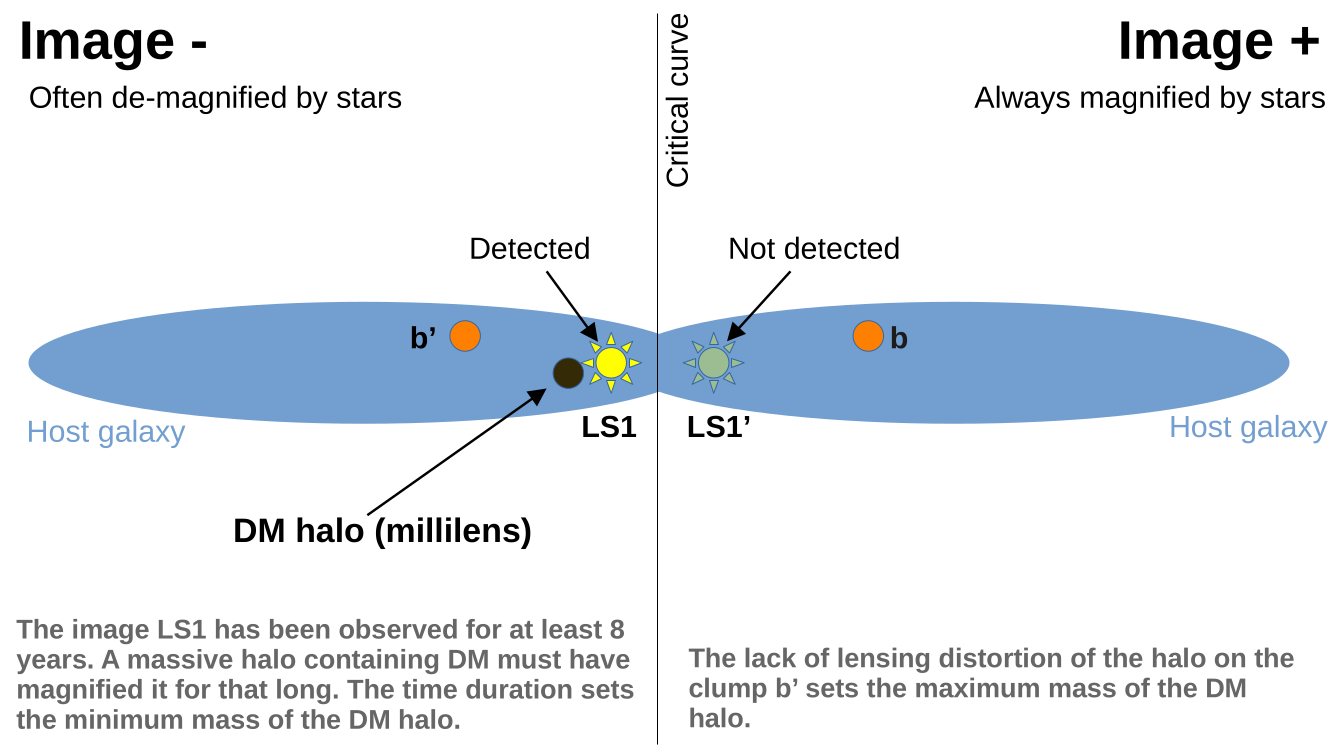
The two blue ellipses represent the double (specular) image of the galaxy hosting the star Mothra. LS1 and LS1′ are the two expected images of Mothra. Only LS1 is clearly detected suggesting that some invisible massive object near LS1 is magnifiying the image of Mothra forming at LS1, but not the other image forming at LS1′ . The black dot represents the approximate position of the halo of DM needed in order to magnify Mothra for at least 8 years. This timescale sets the lower limit of this halo. Masses below 10000 times the mass of the Sun can not magnify LS1 to the required values for 8 years without fine tuning the relative velocities and direction of motion of Mothra. The two red dots represent an unresolved object in the host galaxy that is imaged twice at positions b and b’ (as expected in lensing). These two objects appear with similar brightness in the JWST images, indicating their magnification is not being perturbed by any small structures. This fact is used to set an upper limit on the dark matter halo. It is found that this halo must be at most 2.5 million times the mass of the Sun. Otherwise, the clump c’ would be fainter (demagnified), contradicting the observations. Hence the mass of the black object in the image above is between 10000 and 2.5 million times the mass of the Sun.

This constrain on the mass is used to study possible models of dark matter. One particular model, known as Warm Dark Matter (WDM) predicts that the DM particle is relatively light and moves very fast (almost at relativistic speeds). In this scenario, small structures can not form because the velocity of the DM particle is larger than the escape velocity of the small structure. There is a relation between the mass of the DM particle and the mass of the smallest halo that can exist in this model. From the constrain in the mass of the halo discussed above, astronomers found that models where the DM particle is lighter than 8 keV are in tension with the observations. This is one of the tightest constraints on this type of model coming from astrophysical probes. An alternative model of DM is tested with this observation. It is known as Fuzzy Dark Matter or FDM. In these models, the mass of the DM particle is incredibly small, in the range of 1E-22 eV. Such a small mass has a very large associated De Broglie wavelength (this determines the quantum size) in the astrophysical scale. Lighter masses have longer wavelengths and for very small masses, the wavelength is larger than the size of small galaxies. Since we observe small galaxies around us, this has been used in the past to set a lower limit on the mass of the DM particle for this particular model. From observations of Mothra, one can study the optimal mass range in which the observations would math the predictions from the FDM model. It was found that if the DM particle is in the range of 0.5e-22 eV to 5e-22 eV, the lensing perturbation from the FDM could explain the observations of Mothra (detection of LS1 and non-detection of LS1′). This mass range is interesting because it explains other issues that could be in tension with the standard cold dark matter model, such as the lack of cusps in dwarf galaxies or the possible defficit in the number of satellites around more massive galaxies. Some of these issues can be alleviated with non-exotic baryonic physics but the debate continues about these possible tensions with the standard model. More observations, similar to Mothra, will help in the near future to favor some models against others until we reach the point where only one model survives, or more interestingly, no known model is able to reproduce all observations simultaneously, demanding a new revolution in our understanding of the universe.

Link to the published paper

Eärendel star

Eärendel is found in Norse mythology and Tolkien’s books (morning star).

Eärendel is found in old Norse mythology as a star created by Thor out of one of the toes of Aurvandill. Eärendel was later adopted by Tolkien to refer to the morning star. This reference to an early star is appropriate to talk about Eärendel, the farthest star ever observed.

EärendelThe first stars are expected to form when the universe is between 50 and 100 million years old. Although this may sound as a big number, in reality the universe was still very young at this point. If we compare the universe today (13700 million years old) with a person of 80 years of age, the first 100 million years in the universe would be similar to the first six months of the 80 year old person. That is, still a baby universe. These first stars were expected to be very massive (up to 1000 times the mass of the Sun) and luminous, and composed of basically two elements, Hydrogen and Helium (with traces of Lithium). Given the large size of these stars, they burn very rapidly (like a big fire) and do not live very long (compared with smaller stars like the Sun). After several millions of years these stars die. The death of stars represents one of the most important events for life, since it is then when elements such as Carbon, Oxygen, Iron etc are formed. Eärendel is not one of these first stars, but it could be a star formed from the ashes of these first stars after mixing with more Hydrogen. Eärendel is so far that the light we see from it now started its journey when the universe was still an infant (in Cosmological terms). If we compare again the age of the universe today with an 80 year old person, the light we see today from Eärendel was created when the universe was 5 years old, a universe coming out of its toddler years. The light from Eärendel has been traveling for almost 13000 million years before reaching our telescope (the Hubble Space Telescope to be more precise).

Eärendel and Gravitational Lensing

In its journey toward us, the light from Eärendel has crossed several structures. One such structure is the galaxy cluster WHL0137–08, at approximately 1/4 the distance between us and Eärendel. This cluster is a large collection of galaxies, gas and dark matter, and is so massive that it can bend the space around it. This bending of space makes the light traveling through the cluster to bend as well. The effect is known as gravitational lensing, and is similar to the bending of light when it crosses a dense transparent medium, such as a lens made of glass.

Eärendel is the small dot marked with an arrow. The arc where Eärendel is found is being magnified by a galaxy cluster.

This effect was predicted by Einstein and has been observed many times around very massive objects, like galaxy clusters. The gravitational lensing effect can significantly amplify the light of distant objects, making them detectable with current telescopes. This is exactly what is happening with Eärendel. Without he gravitational lensing effect, we could not have observed Eärendel, but thanks to the amplification from the galaxy cluster, we observe Eärendel thousands of times brighter than what we would have observed without this effect. Other stars at smaller (but still incredibly large) distances have been observed in the past thanks to this effect as well. In the past we have discussed the case of Icarus and more recently Godzilla. All these stars have in common the fact that we are seeing them thanks to the extra magnification provided by gravitational lensing that effectively transforms a relatively small telescope like Hubble into a much larger telescope with a mirror size typically 30 to 70 times larger. Telescopes of this size are impossible to build with current technology, even less if they have to operate from space, but gravitational lensing makes it possible to experience having such a gigantic telescope.

Stars like Eärendel, Icarus and Godzilla are extremely bright and rare but are offering unique opportunities to study the evolution of stars in the earlier epochs of the universe. Future telescopes like JWST working in conjunction with gravitational lenses will push the limits even further and will discover stars even more distant than Eärendel, reaching perhaps the first stars mentioned at the beginning of this post.

Link to research article in Nature and Press releases

A highy magnified star at redshift 6.2

Press release NASA

Press release ESA

Seeing through Dark Matter with gravitational waves

We covered the topic of dark matter before in this post (Dark Matter under the microscope). Dark matter remains one of the bigegst mysteries of Science. One of the candidates for dark matter are Primordial Black Holes or PBH. PBH are black holes that formed during the first instants of the universe. Like dark matter, PBH do not emit light and interact with the rest of the universe basically only through gravity. The LIGO experiment has been detecting a surprisingly high number of massive black holes. The origin of these black holes is uncertain but one of the possibilities is that they could be PBH. We also discussed LIGO detections in this earlier post (Did LIGO really see massive black holes?) . In order to explain the current observations by LIGO, only a fraction of the dark matter needs to be in the form of PBH. In particular, a fraction as small as 1% of the total dark matter would be sufficient to explain the unusually elevated rate of black hole mergers with masses above 20 solar masses.

In a new work we discuss a novel method to explore the possibility that PBH constitute part of the dark matter. Our latest paper (see link at the end of this post) studies for the first time the interference produced when gravitational waves cross a portion of the sky populated with a realistic distribution of stellar bodies (stars, neutron stars or black holes) or microlenses. Earlier work have considered only the simple, but unrealistic, case of isolated microlenses and at most assuming that they are located near a larger lens (galaxy or cluster) but always on the side with positive parity (a tecnicallity that describes one of the two possible configurations for a lensed image). Our work goes further than these simple exmaples by studying the combined effect produced by a realustic population of microlenses and also considers the unexplored regime of macroimages with negative parity (they constitute roughly half  the images produced in the string lensing regime). The figure accompanying this post shows an example of a single microlens embeded in a macrolens and on the side of the lens plane with negative parity. The numbers in orange represent relative time delays (in milliseconds) between the different microimages (the numbers in white indicate the magnification of each microimage and the grey scale shows the magnification in the lens plane with the critical curves shown as two white circular regions. The inset in the bottom-right shows the corresponding magnification in the source plane with the position of two sources, one white and one yellow). At LIGO frequencies (approx 100-500 Hz), a time delay between 1/500 seconds or 1/100 seconds (that is or 2 or 10 milliseconds  respectively)  can produce constructive or destructive interference in the incoming gravitational wave at the detector. For the example in the figure, the microlens has a mass of 100 solar masses. These type of masses where known before to be capable of producing such interference but what our work show is that the mass can still be significantly smaller (a few solar masses) provided several microlenses can work together to produce time delays of order several milliseconds. This cooperative behaviour takes place naturally when one is observing gravitational waves that are being lensed by large factors (of order 100 or more) since in this case, two microlenses which are relatively distant from each other in the lens plane, can overlap their regions of high magnification (known as caustics) in the source plane, if the magnification from the macromodel (galaxy or cluster) is sufficiently large (in a fashion similar to how a magnifying glass works that can bring photons that are separated by some relatively large distance to come together at the focal point of the magnifying glass). Our study shows that interference of a gravitational wave with itself due to microlenses is not only possible, but unavoidable if the magnification from the macromodel is sufficiently large.

This result opens the door to constrain the abundance of PBH. If PBH are as abundant as 1% of the total dark matter, the interference signal observed in detected gravitational waves here on Earth would be significantly different. Next in the list is to study by how much we can constrain this abundance as a function of the mass function of the PBH. Stay tunned …

Preprint to the science article